




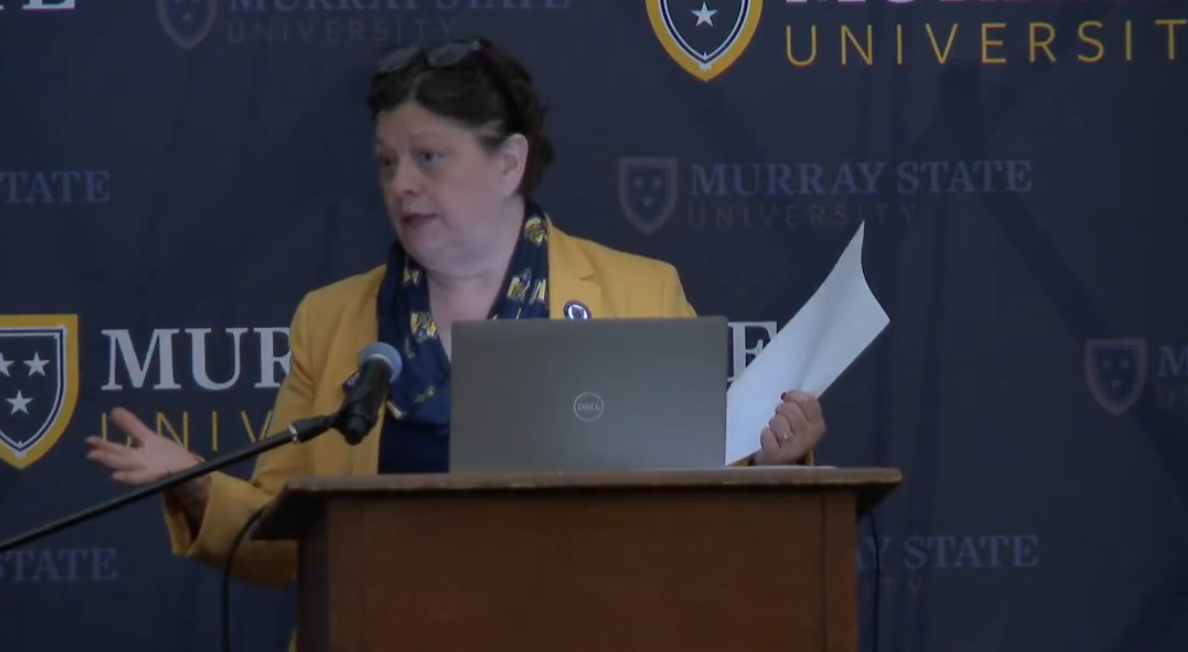









































































The Commonwealth of Kentucky has less than two weeks left in its legislative session, meaning the General Assembly has nearly two weeks to draft and pass new legislation.
At this time, previously The Murray State News reported bills such as House Bills 769, 497, 646 and 773 have not progressed for some time, and will likely die in the legislative process.
These bills respectively involved extending KEES eligibility, tuition waivers for children of disabled or deceased servicemembers, declaring abortion medication a “controlled substance,” and making it a (felony or misdemeanor) to traffic and creating a domestic violence offender registry.
Its exceptions are HB 156, a bipartisan bill which would end child marriage in the state, and the postsecondary education impacting HB 490 — a bill intending to “undercut” tenure in Kentucky.
While HB 156 is still in a read-through process in the Senate, HB 490 and its planned rewrites to the existing standard language for tenure in the state have passed the Senate, and would allow a university to remove a faculty member without exception.
The Senate passed the bill 30-7 on March 27. It has not progressed further in the legislative process with Gov. Andy Beshear.
Ray Horton, a tenured English professor, said this directly affects the education of college students; tenure is supposed to provide a “degree of security” for the faculty of a university.
“Beyond the academic freedom issues, it is telling students at Kentucky’s public universities that they are only worthy of a second-tier education,” Horton said. “(Professors will) pursue their teaching and their research and invest in the institutions that they work for. Without meaningful tenure, professors — faculty are going to leave Kentucky’s public universities, or, you know, look elsewhere when they’re on the job market, to private universities or states that still retain meaningful tenure protections.”
Horton said the language of the bill is vague in its power to remove faculty for any reason. Its exact language may relate to “financial exigency” or financial urgency, low program enrollment, misalignment of revenue and costs and further issues involving poor conduct.
He also said as board of regents’ members are always poltical appointees, this added power would be detrimental to academic freedom.
Horton said while the bill does not require board to act in the manner HB 490 would allow, Ron Patterson, Murray State president, was sent a memo on March 26, by Faculty Senate President Michael Bordieri, expresing the dangers of the bill.
The memo, titled “Why additional statutory authority is not necessary,” said the removal power HB 490 would allow universities, already exists through Murray State’s shared governance.
“The Board of Regents has the authority to declare financial exigency and to eliminate programs, with those determinations informed by structured processes that include faculty participation and institutional review,” the memo reads. “These processes ensure decisions are aligned with academic mission, long-term institutional stability, and public trust.”
According to the memo, the HB 490’s enabling power would disrupt the structure Murray State has for tenure.
It would damage the University’s education, the memo says.
“Tenured faculty positions are structured around an exchange in which qualified individuals accept lower market compensation in return for longterm stability and academic independence,” the memo reads. “If that stability is reduced without a corresponding adjustment to compensation, institutions face a predictable response. Highly qualified faculty are less likely to accept or remain in these roles, weakening recruitment, retention, and program quality.”
Patterson told a News staffer in an interview last month, he does not support the bill and does not want such laws to “drive” Murray State decision.
“We want to be able to work with our shared governance structure, students, faculty and staff as it relates to situations that arise where we have to make cuts,” Patterson said in the interview. “We want to have the flexibility and the latitude to work with those constituent groups to make mission driven decisions.”
The United Campus Workers of Kentucky released a page on their website, asking for 2,000 letters to be written to senators to vote no on HB 490 — now they are sending a pettion with signatures to Beshear.
However, with the Kentucky legislative branch under Republican control, HB 490 is expected to be signed into law via veto override if Beshear does not approve the bill.
The American Association of University Professors also released a statement on HB 490, condemning the “abrupt, chaotic, and destabilizing” nature of the bill.
Todd Wolfson, AAUP president, and Randi Weingarten, American Federation of Teacher president, released a statement on March 26, opposing Kentucky’s potential replacement of “academic stastability with political volatility.”
“The bill’s vagueness leaves the door open for pretextual terminations that would shut down departments and majors, closing doors for students and eliminating their opportunities to learn about a wide variety of topics,” Wolfson and Weingarten wrote. “It prioritizes profit over education and partisan interests over academic achievement. Students who enroll at a Kentucky university intending to study a particular subject could find their education interrupted and their tuition dollars lost if their program is suddenly shuttered.”
Wolfson and Weingarten urge the bill not pass into law.
“Kentucky needs a college-educated workforce that includes graduates who have learned to consider difficult questions from multiple angles,” Wolfson and Weingarten said. “Their education in turn depends on a stable workplace in which instructors are not subject to censorship and retaliation. HB 490 strips away guardrails that prevent partisan interference and weakens protections for academic workers. Removing faculty from the decisions about the curriculum will not strengthen public higher education in Kentucky. Instead, it will diminish educational attainment for students and development for all of Kentucky.