










































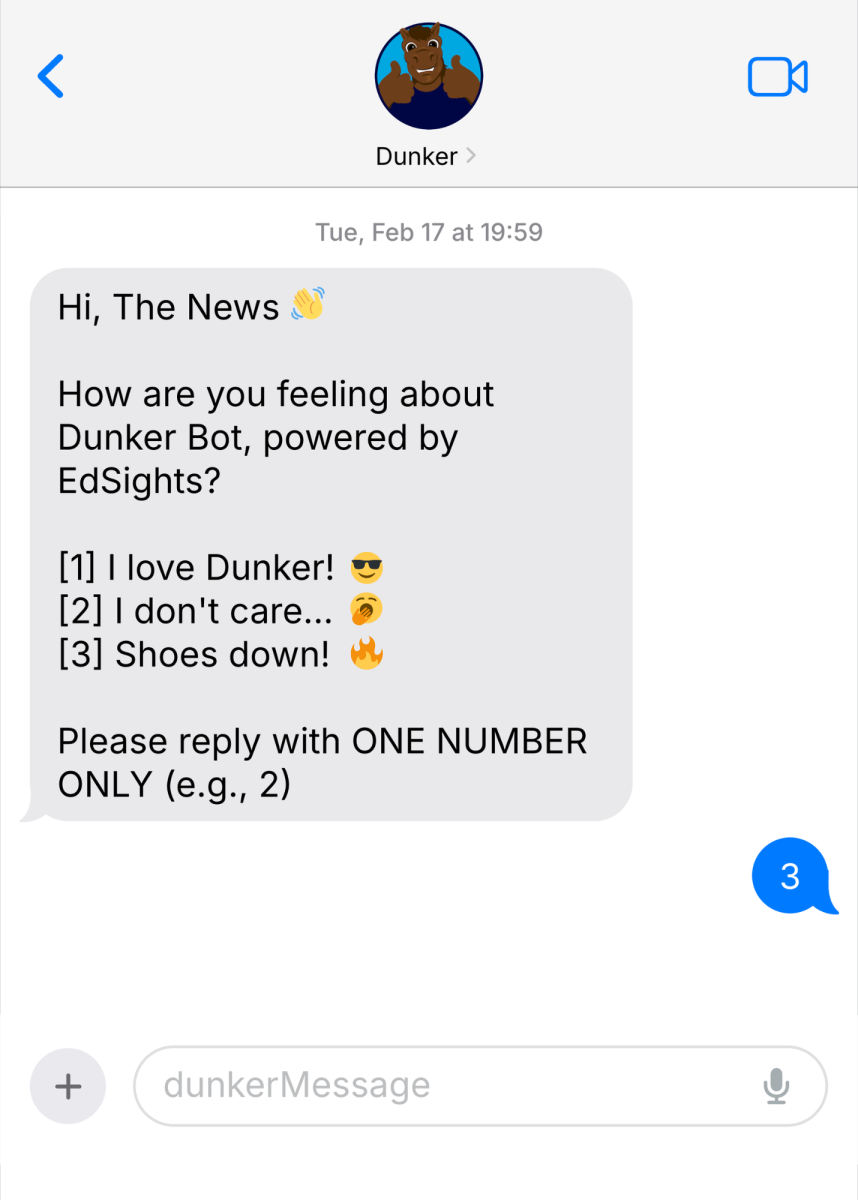




Students from across the country received text messages from robots sanctioned by their university or college.
Some wore the familiar faces of established mascots, and others made their first introductions then and there. Some schools informed students about the incoming texts months in advance, and others gave about a week’s notice.
Each of them was created by EdSights and said it was there to guide students through their academic journey.
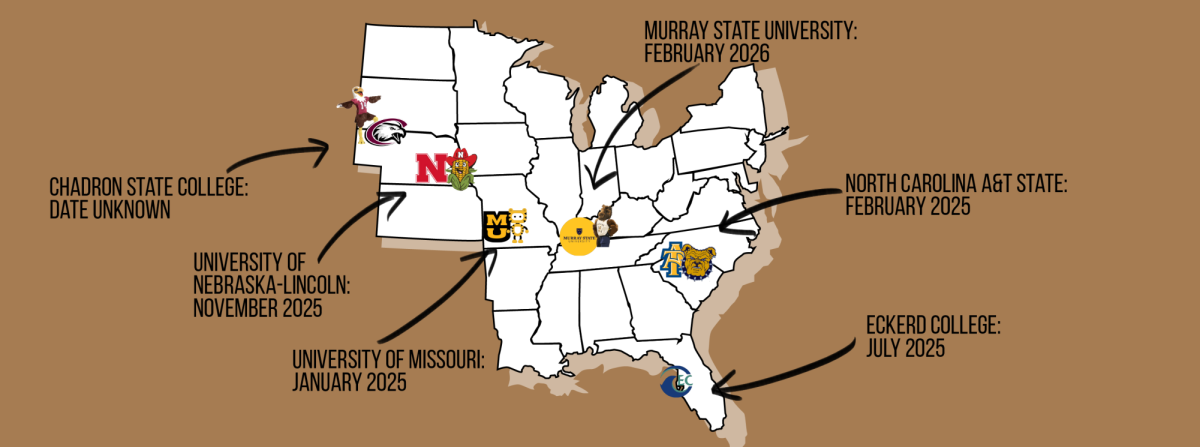
The Murray State News analyzed news coverage and announcements from five other universities or colleges surrounding EdSights chatbots at other college campuses nationwide, finding mixed reactions and potential inconsistencies with how those chatbots were implemented compared to Murray State’s.
Here’s what administrators and students from across the country had to say about their own AI companions.
Chadron State College
Our new digital Dunker could be considered the spiritual successor to Elmo the Eagle of Chadron State College in Chadron, Nebraska, given how Murray State President Ron Patterson suggested the program because of its success at his former place of employment.
The college’s website provides a brief introduction and the phone number where enrolled students “may proactively text Elmo.” The page informs students they can opt out of the program at any time by texting “STOP.”
Austen Stephens, dean of student affairs at Chadron State College, clarified that students were automatically enrolled in the service with the option to opt out and said the intent was to encourage students to start conversations with Elmo outside the established framework of check-in messages.
North Carolina A&T State
North Carolina Agricultural and Technical State University in Greensboro, North Carolina, introduced its students to EdSight’s recreation of Aggie the Bulldog in February 2025. North Carolina A&T became the first historically Black college or university to surpass 15,000 enrolled students in the fall of 2025.
North Carolina A&T’s student newspaper, The A&T Register, published an article informing the university’s student body about the new retention tool and sharing university officials’ explanations of how and why they chose to bring EdSights to North Carolina A&T.
“By simply texting 844-759-1419, continuing students can opt in to an advanced system to receive important information throughout the school year,” the article said. “The 24/7 text service can also answer any university-related questions and conduct feedback surveys with users.”
Eckerd College
The approximately 1,900 students of Eckerd, a private liberal arts college in St. Petersburg, Florida, met their own AI chatbot on July 15 last year. According to Triton Publications, Eckerd’s official student media organization, students were informed of the implementation several months prior, in April, and included in designing the AI’s persona, Ecky the Snail.
Triton Publications said a survey they sent to Eckerd’s student body yielded 84 responses, 79.8% of which felt negatively about the chatbot.
“The majority of respondents who chose to explain their reasoning behind their negative feelings cited environmental concerns as a chief complaint,” the article said. “In addition to environmental concerns, students have reported operational flaws with the chatbot. These complaints range from the bot failing to answer basic questions to the STOP function not working.”
Triton Publications reported that the program had falsely flagged students’ messages for EdSights’ violence, Title IX, mental health crisis and dropout alerts since implementation.
In the article, Eckard’s vice president of student success and student success coordinator said the chatbot was a work in progress and could be the only way some students would comfortably reach out for help, despite student concerns and feedback.
University of Nebraska- Lincoln
At the University of Nebraska-Lincoln in Lincoln, Nebraska, the EdSights chatbot program took the form of an anthropomorphic ear of corn named Cornelius. Cornelius made its debut in early November 2025. An article by The Daily Nebraskan, the university’s independent student publication, was published on Nov. 12, 2025 and said 94% of automatically signed-up students were still “opted in” and clarified that students would have to manually opt out to end communication.
The article quoted University of Nebraska-Lincoln students who had positive and negative impressions of the chatbot, including a student who was “dumbfounded by its inability to even answer simple, campus-related questions” and felt concerned that questions better directed towards advisers were being delegated to “a bot who can’t answer them half the time.”
In addition to student reactions, The Daily Nebraskan reported that an unidentified donor was responsible for the implementation.
“The chatbot created by EdSights is funded through a $1 million donation from a private foundation, which (the senior associate vice chancellor and dean of undergraduate education) declined to identify, for all of the University of Nebraska system’s undergraduate students in Lincoln, Kearney and Omaha,” the article said.
University of Missouri
University of Missouri students in Columbia, Missouri, met Roary, an original personality independent from school mascot Truman the Tiger, on Jan. 22, 2025.
The university’s student news outlet, The Maneater, published an opinion column three weeks later, on Feb. 13, voicing disappointment with the program’s functionality and questioning university officials’ explanation of how it works.
A particular complaint in the column said the university’s deputy AIDE coordinator of the Missouri Students Association described Roary as a “middle man and not … an AI robot,” while the chatbot referred to itself as an “AI tool” in its introductory text.
“A lack of consistent wording makes it unclear if those who created Roary even know what its purpose is supposed to be,” the article said.
The Maneater’s column explained difficulties getting the chatbot to understand questions about the University of Missouri’s campus and student life, including “When is spring break?”
“If MU wants students to start using Roary regularly, those behind the chatbot should further clarify its goals for the chatbot,” the article said. “Until then, Roary’s limited usefulness leaves much to be desired.”
These are just a few of the over 250 schools using EdSights, and the same concerns and justifications from these institutions are now echoed, some three months to a year later, here at Murray State.